
The 2025 State of Denver Restaurants Report
55%
Increase in labor costs since 2019
Labor costs are the largest and fastest-growing expense category for Denver restaurants. Denver's tipped minimum wage has increased 95% in just five years — significantly faster than the overall minimum wage increase of 65% over the same period.
Earnings down 20%
Despite menu prices up 28%
Restaurants needed sales growth of 36–40% since 2019 just to offset rising expenses. Actual sales increased only about 5%. Colorado now has the highest restaurant inflation in the country, with menu prices 5.1% above the national average.
7.9% of Denver's Workforce
13% of the city's sales tax revenue
Restaurants are not a niche industry. They are a critical pillar of both household employment and the municipal budget. When restaurants close, the impact extends to workers, neighborhoods, city services, and Denver's national identity.
More expensive than NYC
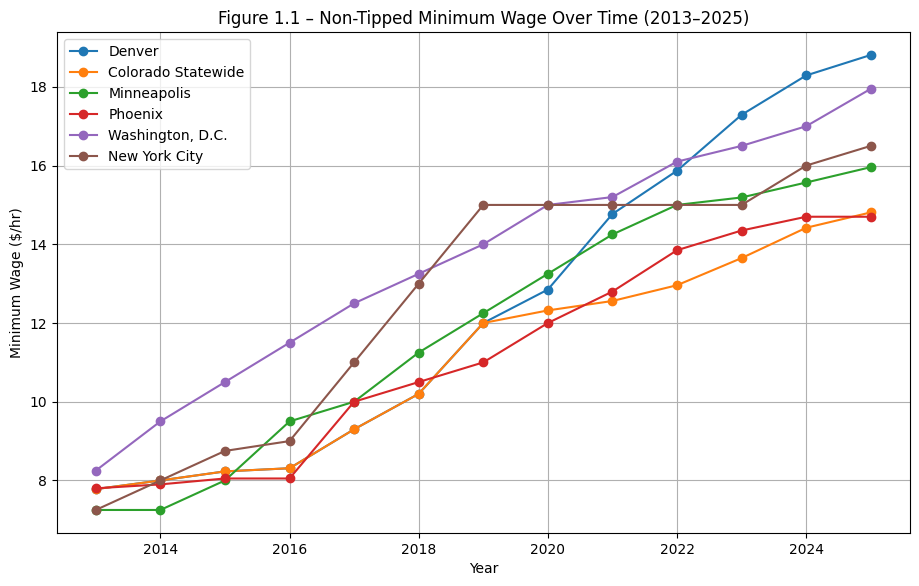
Denver's minimum wage has outpaced Tier One cities
Denver's minimum wage has reached 259% of the federal rate, compared to New York City's 228%. But Denver doesn't have the population density, global tourism, or economic scale that helps those cities absorb the costs.
Neighborhoods in decline
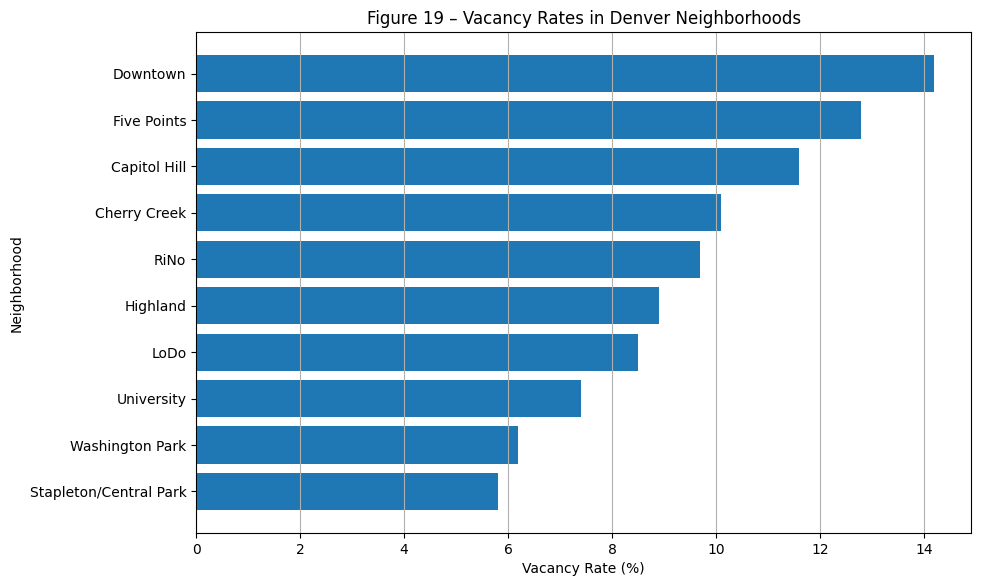
Corridors that define Denver are disappearing
Once-vibrant restaurant corridors — including RiNo, Colfax, South Broadway, Sunnyside, LoHi, and Uptown — were described as "dying" or "significantly diminished." Cherry Creek is the only submarket with near-full occupancy, but costs there are so high that only the most capitalized concepts can participate.
FAQs
-
Between 2019 and 2024, Denver lost 6% of its overall restaurant jobs and 15% of full-service restaurant jobs. Labor costs have increased 50–55%, with the tipped minimum wage up 95%. Restaurant earnings have fallen 20%. Denver is estimated to be missing 10,000–15,000 restaurant jobs. The report finds this is a structural contraction, not a temporary downturn.
-
The report identifies four interconnected pressures: rapidly escalating labor costs (primarily driven by minimum wage increases outpacing revenue growth), rising fixed costs (rent up 23%, cost of goods up 22%, insurance and property taxes up 30%), regulatory and permitting barriers, and public safety concerns that reduce foot traffic and shorten operating hours.
-
The tip credit (also called a tip offset) allows restaurants to pay tipped employees a base wage below the full minimum wage, ONLY as long as tips make up the difference. No tipped worker can legally earn less than the full minimum wage—the employer must cover any shortfall. The tip credit affects how the minimum wage is financed between employer and customer tips, not whether workers receive the full minimum wage. For a detailed explanation, see our Understanding the Tip Credit page.
-
In 2019, Denver City Council passed an ordinance creating a new local minimum wage significantly above the state rate, with annual increases tied to the Consumer Price Index and no cap. The ordinance requires no review by legislators; The increases happen automatically, every year, in perpetuity. Since then, Denver's minimum wage has grown 74% (from $11.10 to $19.29).
At the same time, Colorado's tip credit has been frozen at $3.02 since 2006. As Denver's minimum wage has climbed, the fixed tip credit has covered a smaller and smaller share, meaning restaurants absorb nearly the entire increase. Denver's tipped minimum wage has grown 101% since 2019 — significantly faster than the overall minimum wage — because the tip credit no longer provides any meaningful offset.
The result is that Denver's minimum wage trajectory now rivals Tier One cities like New York, San Francisco, and Washington, D.C. But Denver is a Tier Two city without the population density, global tourism, or economic scale that allows those markets to absorb such costs.
-
The report outlines a range of policy options across labor and affordability, regulatory modernization, and public safety. These include rebalancing how restaurant wages are financed, streamlining permitting, developing commercial affordability tools, and investing in clean-and-safe corridor initiatives. Many of these actions are within Council’s existing authority.
On the wage front specifically, the data suggests that restoring the employer-paid share of the minimum wage to roughly where it was in 2019 — approximately 74%, compared to the current 84% — would meaningfully relieve cost pressure without reducing any worker's guaranteed minimum wage.
Importantly, the 2025 Colorado legislative session gave Denver City Council the explicit authority to make this kind of adjustment: HB25-1208 allows local jurisdictions with minimum wages above the state minimum to modify their tip credit. Other Colorado communities like Edgewater have already begun making similar adjustments, and cities like Chicago and Washington, D.C. maintain significantly larger tip credits than Denver despite having lower minimum wages. Denver has not taken action yet.
-
No. No policy being discussed would reduce any worker’s total compensation below the full minimum wage. Tipped workers in Denver’s full-service restaurants routinely earn $35–$50+ per hour when tips are included. The discussion is about creating a more sustainable system for financing those wages so restaurants can stay open, continue employing people, and address long-standing wage inequity between Front of House and Back of House workers.
In fact, the greater risk to tipped workers' income comes from the opposite direction. In cities where the tip credit has been eliminated entirely — like Chicago and D.C. — restaurants have responded by adding service charges, reducing hours, and shifting to counter-service models that reduce or eliminate tipping altogether. Those changes directly threaten the tip income that thousands of Denver workers depend on. A sustainable tip credit protects the tipping system and the income it generates for workers, while ensuring every worker is still guaranteed the full minimum wage.
-
While Denver has contracted, restaurant employment across the rest of Colorado (excluding Denver) grew 3.3% between 2019–2024. Other Front Range communities are already taking action: Edgewater became the first Colorado city to adjust its tip credit under the authority granted by HB25-1208, and Boulder is actively considering similar steps. Denver — the city where the crisis is most acute — has not yet acted.
-
The report is a comprehensive study published by Visit Denver and Denver Economic Development & Opportunity (DEDO), conducted in partnership with inKind and led by consulting firm Cumulus, Etc. It draws on surveys of 150+ restaurants, 50+ in-depth interviews, five industry roundtables, commercial broker sessions, and national datasets to provide a data-driven assessment of Denver’s restaurant sector.
-
Yes — and what's happening in those cities is instructive.
In Chicago, the City Council passed a One Fair Wage ordinance in October 2023 to fully eliminate the tip credit by 2028. The phase-out has been deeply contentious: the Illinois Restaurant Association reported 496 restaurant closures in the first half of 2025, and in March 2026, the City Council voted 30-18 to freeze the phase-out. The mayor vetoed that freeze, and the fight continues. Chicago's current tipped minimum wage is $12.62 on a $16.60 overall minimum — already the subject of an intense political battle over whether the industry can absorb further increases.
In Washington, D.C., voters overwhelmingly passed Initiative 82 in 2022 to eliminate the tipped minimum wage entirely by 2027. By mid-2025, the impact on restaurants was severe enough that the D.C. Council voted 7-5 to overhaul the law — freezing the tipped minimum wage at $10.00, slowing future increases, and capping the tipped wage at 75% of the full minimum wage through 2034. The Washington Post editorial board called the original initiative "an economic disaster."
The pattern is consistent: cities that moved aggressively to eliminate or dramatically reduce the tip credit are now pulling back as the consequences for restaurants and workers become clear. Denver has an opportunity to learn from these experiences rather than repeat them — but only if City Council acts to rebalance the system before the pressure reaches the breaking point.