
Understanding the tip credit:
The tip credit is one of the most misunderstood policies in the restaurant industry. Whether you're a policymaker, a reporter, a restaurant worker, or a customer, here's what you need to know.
What is the tip credit?
When you leave a tip at a restaurant, that money goes to your server or bartender. But tips also play a role in how restaurant wages are structured under the law.
In Colorado, restaurants are allowed to pay tipped food-and-beverage employees a base wage that is lower than the standard minimum wage, as long as tips make up the difference. The gap between the full minimum wage and the lower base wage is called the "tip credit" or "tip offset."
Here's what's important: there is no circumstance in which a tipped restaurant employee can be paid less than the full minimum wage in their community. If a tipped worker's base wage plus tips don't add up to the full minimum wage in any given week, the employer is legally required to pay the difference. This is not optional — it's the law, enforced by the Colorado Department of Labor.
The tip credit doesn't determine whether workers receive the minimum wage. It determines how that wage is financed: the share paid directly by the employer versus the share covered by customer tips.
How the tip credit works in Colorado:
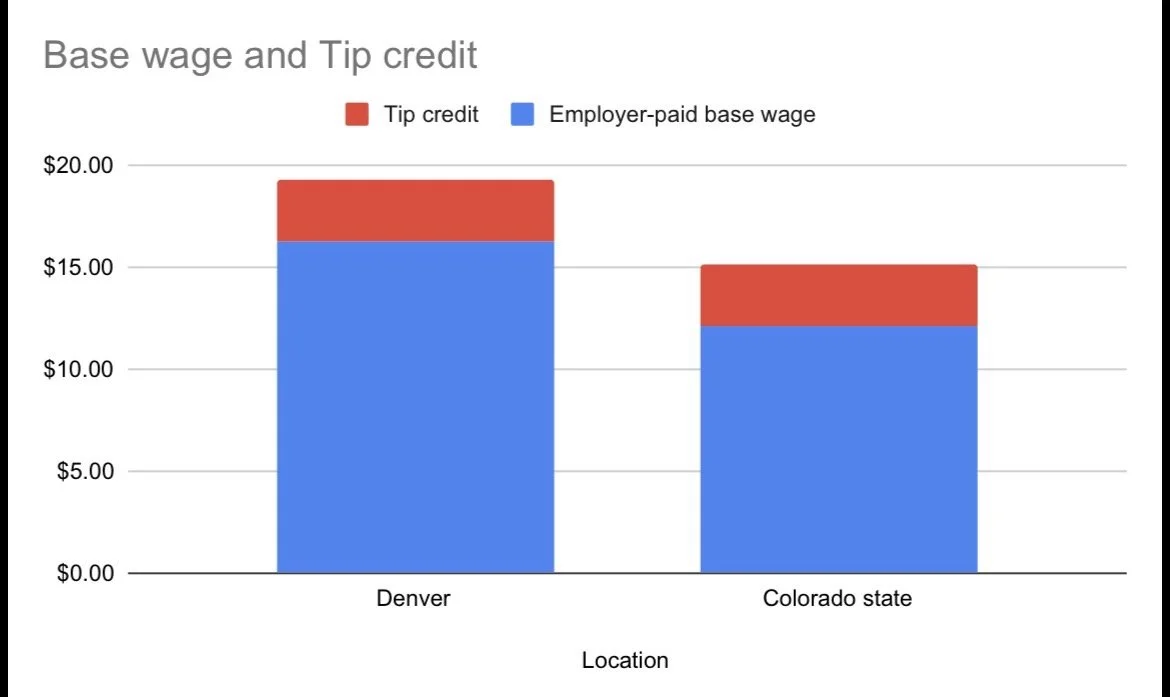
Colorado's tip credit is set in the state constitution at $3.02 per hour. It has not changed since it was established in 2006.
At the state level, this means:
State minimum wage (2026): $15.16/hr
Tip credit: $3.02/hr
Tipped base wage: $12.14/hr (the minimum an employer must pay before tips)
In Denver, where the local minimum wage is higher:
Denver minimum wage (2026): $19.29/hr
Tip credit: $3.02/hr (same fixed amount)
Tipped base wage: $16.27/hr
Because the tip credit is a fixed dollar amount — not a percentage — its impact shrinks every time the minimum wage goes up. When the tip credit was first set, it represented a 57% offset against the state minimum wage. Today, it represents just 16% of Denver's minimum wage.
How Denver compares:
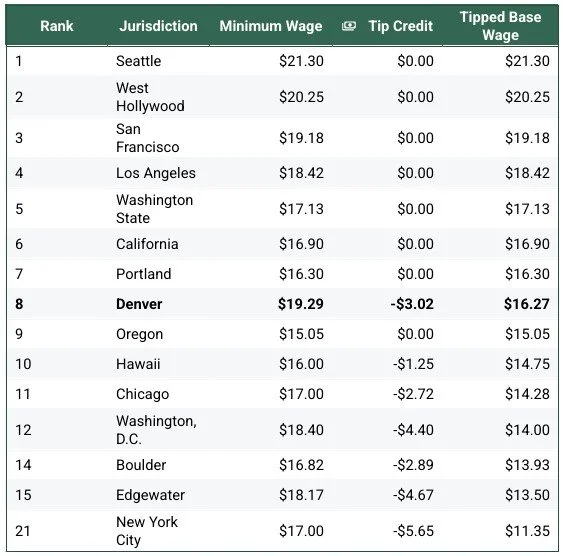
Denver's tipped minimum wage — the base wage employers must pay before tips — is the 8th highest in the country. It sits just below a handful of jurisdictions that have eliminated the tip credit entirely, meaning employers pay the full minimum wage regardless of tips.
Notice that Denver's overall minimum wage ($19.29) is higher than New York City's ($17.00), but Denver's small $3.02 tip credit means Denver restaurants pay a tipped base wage of $16.27 — nearly $5.00 more per hour than New York City restaurants pay ($11.35).
Denver's position on this list is striking for another reason: the cities ranked above Denver all have no tip credit at all — they made a deliberate policy choice to eliminate it. The cities ranked below Denver — including Chicago, Washington, D.C., and New York City — all have significantly larger tip credits, meaning employers in those cities pay a smaller share of the minimum wage directly. Denver has the worst of both worlds: a high minimum wage with an almost negligible tip credit.
Edgewater and Boulder, two Colorado communities facing similar pressures, have already begun to address this. Edgewater adjusted its tip credit to $4.67 in December 2025, bringing its employer-paid share closer to where Denver's was before the gap began accelerating. Boulder is navigating the same conversation.
Why this matters for Denver restaurants:
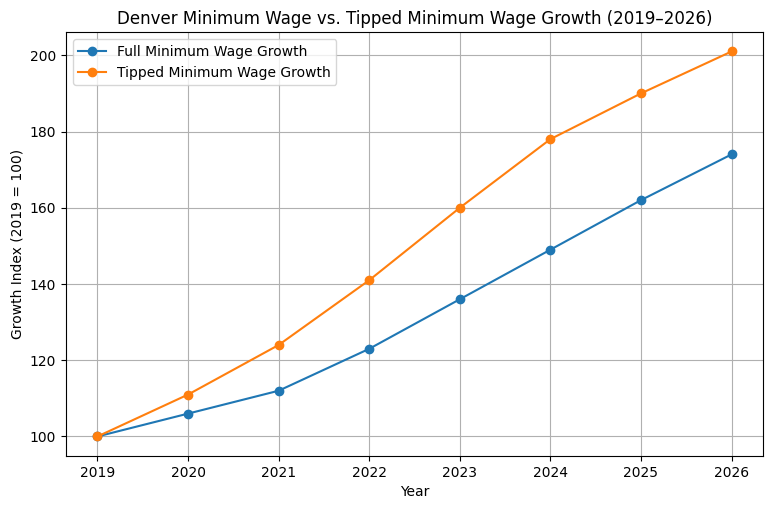
Because Denver's minimum wage increases every year based on inflation — but the tip credit has been frozen at $3.02 — the employer-paid share of the minimum wage has grown dramatically.
In 2019, Denver's tip credit covered about 27% of the minimum wage. Employers paid the remaining 73%.
By 2026, the tip credit covers just 16% of the minimum wage. Employers now pay 84%.
Denver's tipped minimum wage has increased by 101% since 2019. The overall minimum wage has increased by 74% over the same period. The tipped wage is rising significantly faster because the fixed tip credit absorbs a smaller and smaller share of each increase.
Had Denver's tip credit increased at the same rate as the minimum wage since 2019, it would be approximately $5.00 today, and the tipped base wage would be $14.31 instead of $16.27.
This growing gap is a significant driver of the labor cost pressures identified in the 2025 State of Denver Restaurants Report. According to that report, labor costs for Denver restaurants have increased 50–55% since 2019, with operators overwhelmingly identifying the tipped minimum wage trajectory as the primary cause.
To put this in practical terms: in 2019, Denver employers paid approximately 73% of the minimum wage directly, with the tip credit covering the rest. Today, employers pay 84%. If Denver were to restore even the 2019 ratio — with employers paying roughly 74% of the minimum wage and the tip credit adjusting proportionally — it would bring Denver in line with where the system was before costs began accelerating out of control, without reducing any worker's guaranteed minimum wage.
That's not a radical change. It's a recalibration to the ratio that was already in place when Denver's restaurant economy was growing.
What changed in 2025:
In June 2025, Governor Polis signed HB25-1208 into law. For the first time, the law gave local governments with minimum wages above the state rate the authority to adjust their own tip credits.
The law does not require any city to act — it gives them the option. Each community can decide what works best for its restaurants and workers.
Two Colorado communities have already moved forward. Edgewater became the first city to use this authority, adjusting its tip credit to $4.67 in December 2025 — a change that restaurant owners in that community have described as essential to their survival. Boulder is actively considering similar action.
Denver — the city where the crisis is most severe — has not yet acted.
Nationally, cities like Chicago and Washington, D.C. are also navigating the tension between rising minimum wages and restaurant sustainability. Both cities maintain significantly larger tip credits than Denver, allowing their restaurants more flexibility even though their minimum wages are lower. Denver's combination of a high minimum wage and a near-negligible tip credit is virtually unique among major American cities.