
the 2025 state of denver restaurants report
challenges facing the sector
In February 2026, Visit Denver and Denver Economic Development & Opportunity (DEDO) published the most comprehensive study of Denver's restaurant industry ever conducted. The findings confirm what restaurant operators have been experiencing for years — and the data demands a response.
The report was produced through the Denver Restaurant Liaison Project, a six-month strategic effort led by Cumulus, Etc. (Adam Schlegel) and industry veteran Dana Faulk Query, in partnership with inKind. It draws on surveys, financial data, interviews, and national datasets to provide policymakers with an honest, data-driven assessment of where Denver's restaurant sector stands and what can be done about it.
key findings
55%
Increase in labor costs since 2019
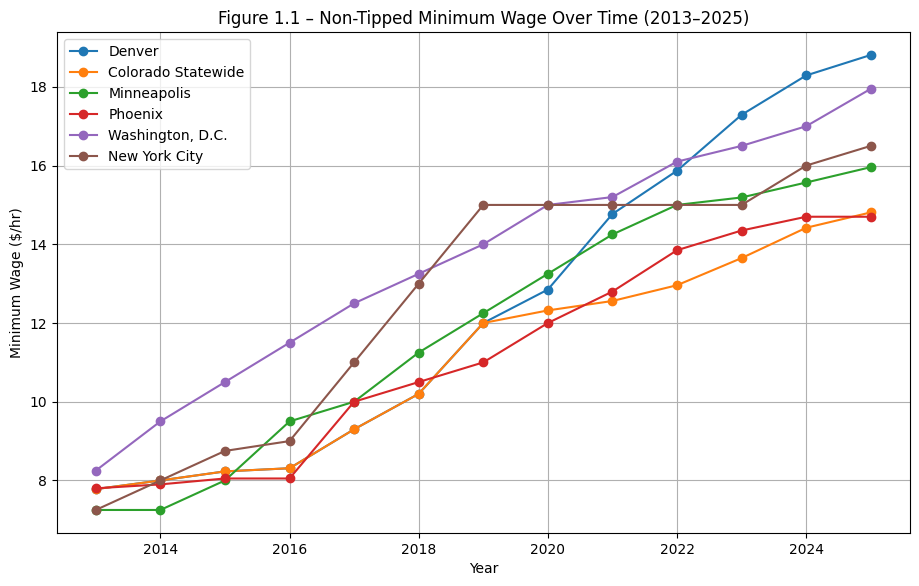
Labor costs are the largest and fastest-growing expense category for Denver restaurants. Denver's tipped minimum wage has increased 95% in just five years — significantly faster than the overall minimum wage increase of 65% over the same period.
Labor costs are the largest and fastest-growing expense category for Denver restaurants. Denver's tipped minimum wage has increased 95% in just five years — significantly faster than the overall minimum wage increase of 65% over the same period.
MORE EXPENSIVE THAN NYC
Denver's minimum wage has outpaced Tier One cities
Denver's minimum wage has reached 259% of the federal rate, compared to New York City's 228%. But Denver doesn't have the population density, global tourism, or economic scale that helps those cities absorb the costs.
10,000–15,000
Missing restaurant jobs
Denver lost 6% of its overall restaurant jobs and 15% of full-service restaurant jobs between 2019 and 2024, while the rest of Colorado grew by 3.3%. Factoring in pre-pandemic growth trends, the city is missing an estimated 10,000–15,000 jobs that would exist today.
Neighborhoods in decline
Corridors that define Denver are disappearing
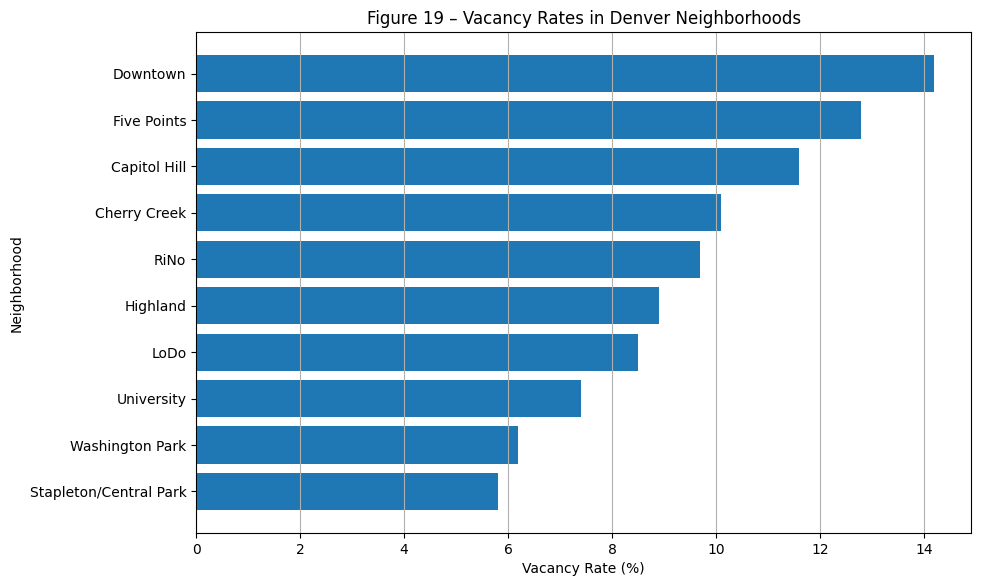
Once-vibrant restaurant corridors — including RiNo, Colfax, South Broadway, Sunnyside, LoHi, and Uptown — were described as "dying" or "significantly diminished." Cherry Creek is the only submarket with near-full occupancy, but costs there are so high that only the most capitalized concepts can participate.
Earnings down 20%
Despite menu prices up 28%
Restaurants needed sales growth of 36–40% since 2019 just to offset rising expenses. Actual sales increased only about 5%. Colorado now has the highest restaurant inflation in the country, with menu prices 5.1% above the national average.
7.9% of Denver's workforce
13% of the city's sales tax revenue
Restaurants are not a niche industry. They are a critical pillar of both household employment and the municipal budget. When restaurants close, the impact extends to workers, neighborhoods, city services, and Denver's national identity.
THE COST PICTURE
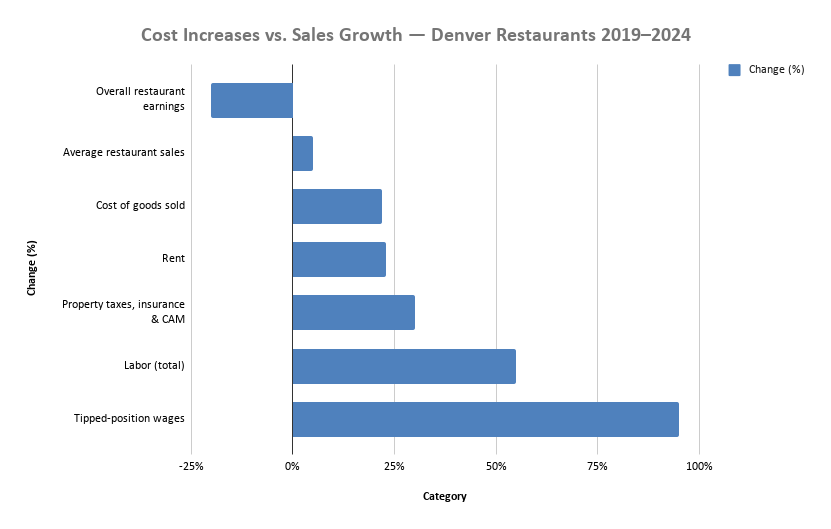
Between 2019 and 2024, every major cost category for Denver restaurants increased significantly:
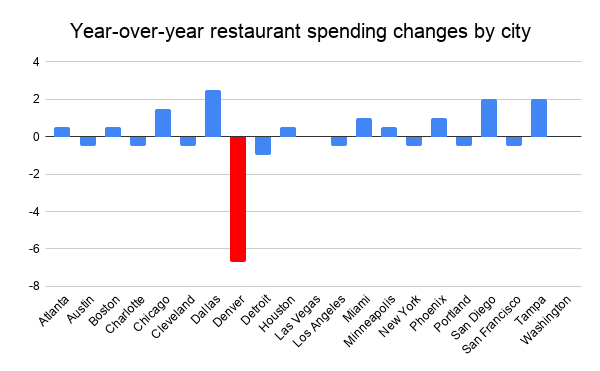
Meanwhile, average restaurant sales increased just 5% — and overall earnings fell 20%.
Operators are stuck in an impossible position: hold prices steady and risk insolvency, or raise prices further and risk losing customers who are already paying more for dining in Denver than in nearly any other American city.
what the report recommends
The report identifies policy options across four domains — all within Denver City Council's authority or influence:
Labor & Wage Policy: Rebalancing how restaurant wages are financed to slow job loss and business contraction while maintaining strong wage standards. The report notes that Denver's employer-paid share of the minimum wage has grown from 73% in 2019 to 84% in 2026. Restoring a ratio closer to where the system was before costs began accelerating — while still guaranteeing every worker the full minimum wage — would provide meaningful relief. Tools include adjusting the tip credit and creating pathways for whole-house tip-sharing models. Edgewater and Boulder have already begun acting on similar measures; nationally, cities like Chicago and Washington, D.C. maintain significantly larger tip credits despite having lower minimum wages.
Regulatory Modernization: Streamlining restaurant permitting, reducing multi-agency review timelines, and making it easier for new restaurants to open and existing ones to change hands. Architects and contractors surveyed for the report describe Denver as one of the most difficult permitting environments in the Front Range.
Commercial Affordability: Developing rent stabilization tools, gap financing, and landlord partnership incentives for small and independent restaurants in designated hospitality corridors.
Public Safety & Neighborhood Vitality: Implementing coordinated clean-and-safe corridor initiatives, strengthening partnerships between restaurants, Business Improvement Districts, and public safety agencies, and integrating safety considerations into economic development planning.
The report does not prescribe a single solution. It presents a framework of interconnected policy options that, taken together, address the structural pressures driving the contraction.
HOW THE REPORT WAS BUILT
The Denver Restaurant Liaison Project used a mixed-methods approach combining quantitative analysis with extensive stakeholder engagement:
Download the full report
The full report is 68 pages and includes detailed findings, financial case studies, national comparisons, and the complete policy framework.
For a summary of how the tip credit works and how Denver compares to other cities, see our Understanding the Tip Credit page.